AI CHARACTERS · THE ART OF KAMA MUTA, PART 7
The script said she zipped the phone into her bag with care. So the bag had to be in every frame. Furthermore, it had to have a zip, and her hand had to rest on it as if by habit. The script said she stood on a street in October and raised an empty hand. So the coat had to be long enough to read as autumn and open enough to show the hand. The script said her daughter arrived as the opposite of her. So the daughter’s jacket had to be the colour the mother never wore. None of those decisions, however, were about looking good. They were about the story, and the character sheet that came out of them is the one you can see in this article.
At a glance
- The character is defined by the script before any sheet is made. Her description comes from the relationship sentence, her posture and wardrobe from the vulnerability, the object she carries from the callback.
- The second character is designed as the closeness that arrives, which usually means designed as a contrast.
- Only then is the sheet built, with the turnaround, the wardrobe lock and the Soul ID from the character continuity series.
- A wardrobe lock written from the story is also a continuity tool. Every detail has a reason to be there and a reason to stay.
- Real people in a real story appear only as the finished film, never as sheets.
You will need: your script from part 6, and the character continuity method from this blog.
The Character Comes From the Sentence
Start with the relationship sentence from short film story structure built on one feeling. This is a story about a mother and a daughter, who begin emotionally side by side but looking at screens, until a stolen phone suddenly changes the connection between them. In fact, everything the sheet needs is already in it.
First, a mother, so an age that reads as a mother of a grown daughter without a line of dialogue. Side by side but looking at screens, so a posture that is absorbed and self-contained in the first frames, then open in the last. Finally, a stolen phone, so a bag, a zip, a hand. The sentence gives the character her age, her default posture, and the single object the whole film turns on. Write those three down before you open any tool.
The Vulnerability Becomes the Wardrobe
The vulnerability in the nine beats was this. She keeps every photograph of the last ten years on the phone and zips it away with care. In other words, that is a person who protects what she loves and keeps it close. The wardrobe should say so. For the phone film, that meant a long coat worn open, which protects and reveals at once. Underneath, a knitted dress that reads as warmth, because warmth is what she offers. On the hip, a structured leather bag worn close rather than swinging.
Colour follows the same logic, too. Greys for the ordinary world, so the film can live in a muted London palette without her disappearing into it. One deep colour, a burgundy, on the collar, the belt, the boots and the bag. The eye finds her in the wide shots, and the hand finds the bag in the close ones. In short, none of this is a style choice. It is the vulnerability made wearable.
The Callback Object Goes Into the Lock
In the phone film, the opening callback is the phone, zipped into the bag. Whatever object returns at the end has to be in the wardrobe lock, with its position. That is how it holds in every frame it appears in. For example, the lock reads like this. A structured burgundy leather tote with two rolled handles and a zip closure. Worn on the right shoulder or carried in the right hand. Her left hand rests on the zip when standing. That line, in practice, is the difference between a bag in the first shot and the same bag in the eighth.
The same rule applies, of course, to any callback object: the coat on the hook, the recipe card, the second plate. It is written into the lock with its position, its colour and its state, and it never changes unless the story changes it.

The Second Character Is the Closeness That Arrives
The daughter is not a second protagonist. Instead, she is the turn. She exists to close the distance, so she is designed as everything the mother is not in the first frames. Younger, obviously. Then dark hair tied back where the mother’s is loose in a high ponytail. A short dark green utility jacket where the mother’s coat is long and grey. Hands free where the mother’s hold a bag. As a result, when she takes the hand, the contrast makes the closeness visible.
For the frames in this series the daughter is a fictional character with a one-line sheet. The real daughter in my own film appears only as the film, never as a sheet. That is the fifth restraint rule from the emotional arc of a short film, and it is also simple safety. A turnaround is a cloning kit, whereas a lit, moving frame is a film. So publish the film.

Only Now, the Sheet
Once the age, the posture, the wardrobe, the object and the contrast are written down, the sheet is a known process. The turnaround, the wardrobe sheet and the Soul ID are built the way the character series teaches, in how to create a consistent AI character from scratch and building a Higgsfield character sheet. The only difference is that every line of the wardrobe lock now has a reason. That makes it far easier to hold, because you know what cannot change and why.
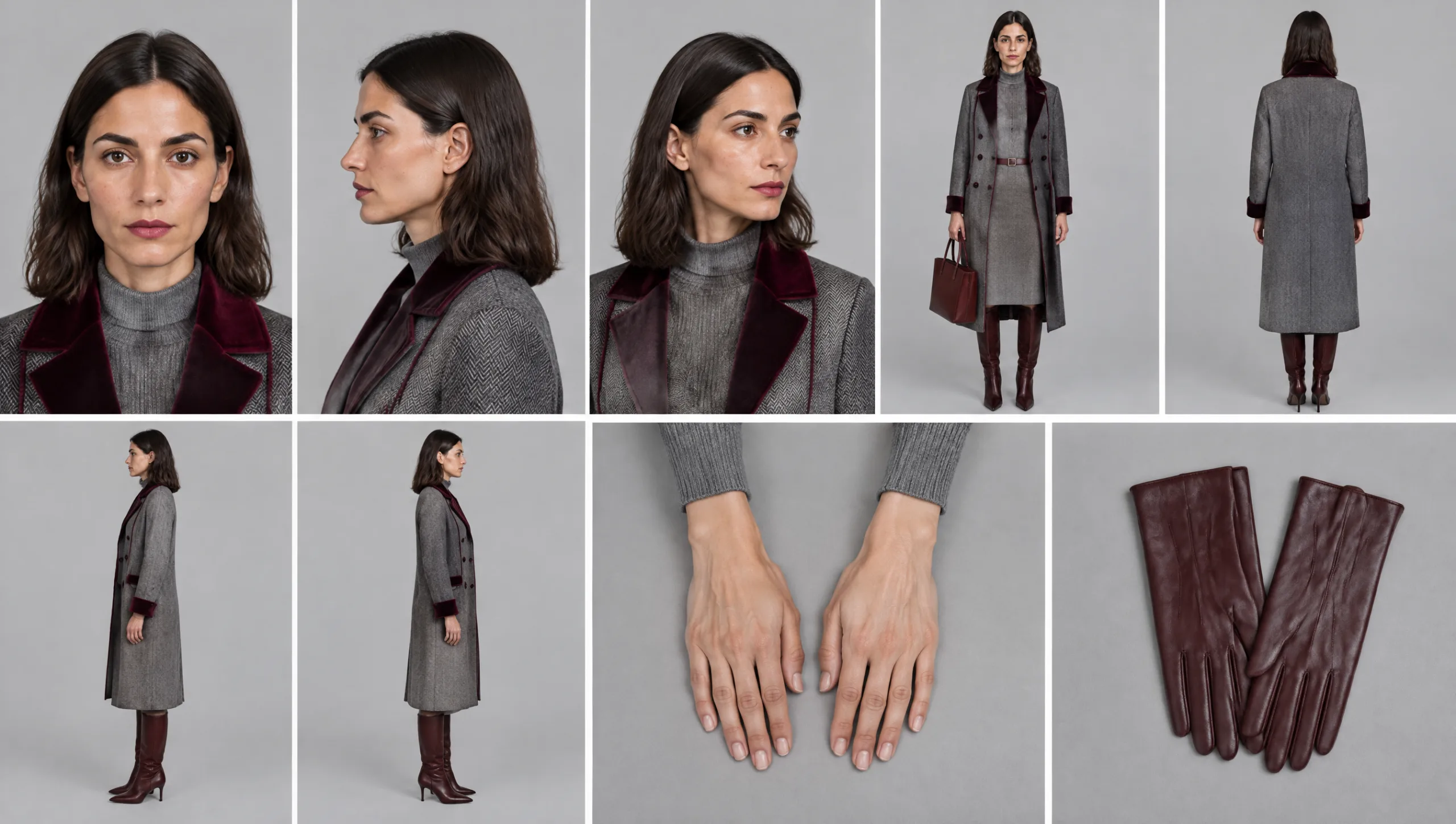
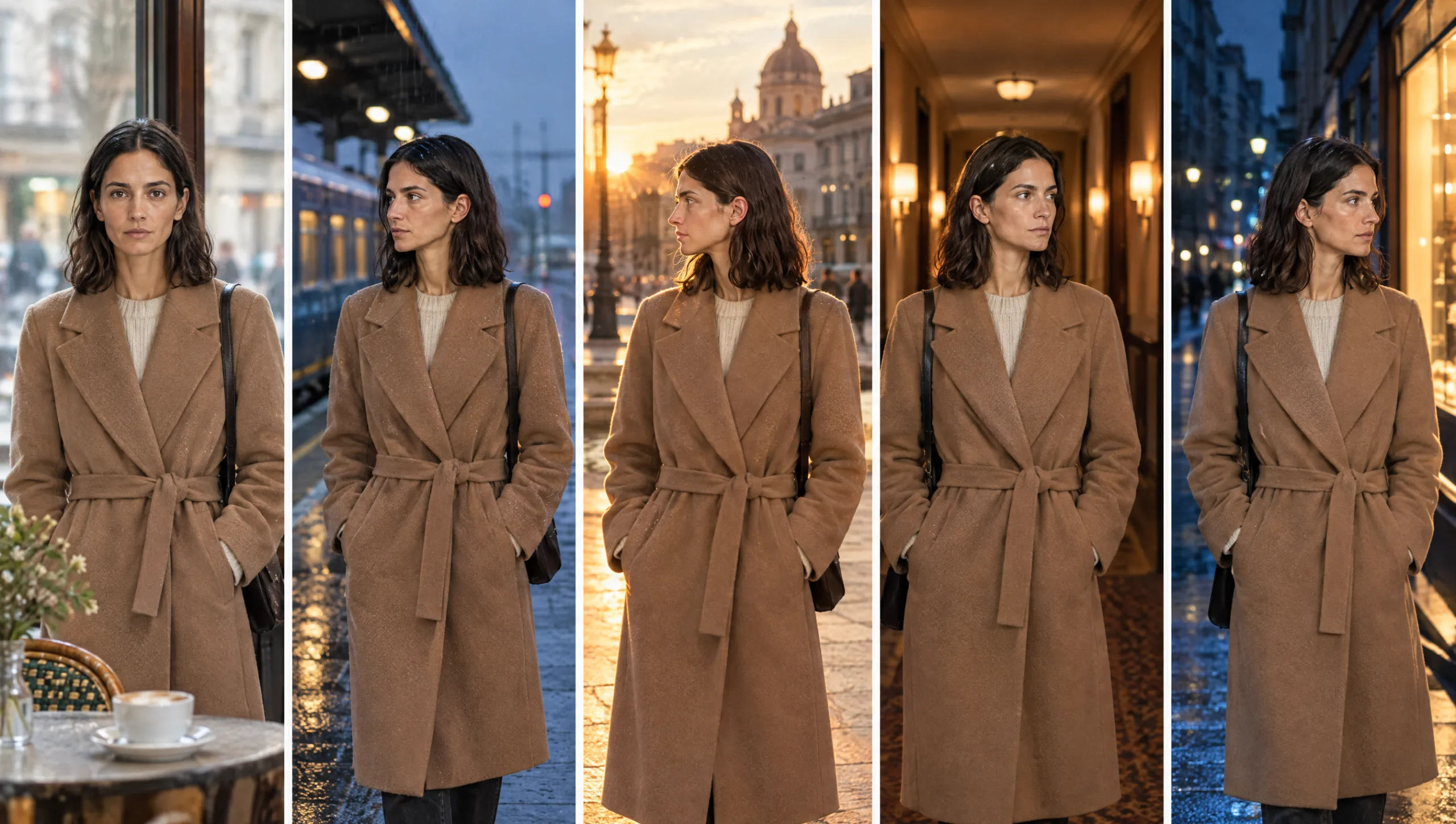
Mara’s sheet for this series was built exactly this way. A nine-panel turnaround in a grey studio, with the dress and belt, the coat, the boots, and the bag in the front panel. Then bare hands in one panel, and the gloves on their own in the last, in case a scene wants them. The twelve cinematic frames that run through every article in this series came from that sheet and the locked wardrobe. That is why the coat is the same coat in the extreme wide and the extreme close-up.


Three Prompts for the Character
Prompt 1: From Sentence to Character
First, the prompt that does the reading for you.
Here is my relationship sentence: [PASTE IT]. Here is the vulnerability beat: [PASTE IT]. Here is the opening callback: [PASTE IT]. From these only, write a character brief in four lines: age and presence that read without dialogue; default posture in the first frames and posture in the last; the wardrobe as a reason, not a style, with one dominant colour and one accent; the callback object with its exact position on the body. Do not add anything the story does not need.Prompt 2: The Contrast Character
Next, a second pass on the result.
Here is the brief for my protagonist: [PASTE IT]. The second character exists to close the distance at the turn. Design them as a contrast in four lines: age, hair, one wardrobe piece, and what their hands are doing. Each line must be the opposite of the protagonist's in a way the camera can see in one frame. Then write one line of wardrobe lock for them, with colours and position, for continuity.Prompt 3: The Wardrobe Lock From the Story
Finally, the check that decides whether it is ready.
Here is my character brief: [PASTE IT]. Write the wardrobe lock as a single paragraph of plain sentences, item by item: colour, material, length, how it is worn, where the hands rest. Include the callback object with its position and state. Finish with the three details that must never change between frames, and one sentence explaining what each of them means in the story.From the Character to the Camera
The sheet exists to be filmed, and so the next article is about filming it: which shot size carries which beat, how the camera moves from distance to closeness, and why the extreme close-up of the hands is the physical evidence. That is shot sizes and emotion. The whole method on one page is The Art of Kama Muta.
Common mistake
A beautiful character with nothing to do. The sheet is gorgeous, the face holds, the wardrobe is perfect. There is no object in her hands and no reason for her posture. Consequently she can stand in any film, which means she belongs to none. The fix is to go back to the sentence. Ask what she carries, how she stands, and what the audience must see on her body at the lowest beat.
A note from Patchy
Quick version
The character comes from the script. Her age, posture and the object the film turns on come from the relationship sentence. Then the vulnerability becomes the wardrobe, as a reason rather than a style. The callback object goes into the wardrobe lock with its position so it holds in every frame. The second character is the closeness that arrives, designed as a contrast. Only after that is the sheet built with the turnaround, wardrobe lock and Soul ID. Real people appear as the film, never as sheets.
Your move
Run Prompt 1 on your sentence, vulnerability and callback, and write the four lines on the same card as your connection contrast. However, if the fourth line, the object and its position, is empty, your script has no callback yet, and that is the thing to fix before any sheet.
Get the prompts. All three prompts from this article are in the free Prompt Library under Characters.
Related articles
- The Art of Kama Muta, the pillar guide
- creating a consistent AI character from scratch
- how to keep an AI character’s wardrobe consistent
- putting two AI characters in one scene
Paid next step: The AI Character Continuity System, the full method for the turnaround, the wardrobe lock and the Soul ID, now with a reason behind every line.
Frequently Asked Questions
Should I create the character before or after the script?
After, because the script tells you her age, her posture, her wardrobe and the object she carries. A character made before the script can stand in any film and belongs to none.
How do I choose an AI character’s wardrobe?
From the vulnerability in the story. Ask what the character protects, keeps close, or hides, and dress her so the camera can see it. One dominant colour, one accent, and the callback object in the lock.
How do I design the second character in a two-person film?
As a contrast. The second character exists to close the distance, so make them the opposite of the protagonist in age, hair, one wardrobe piece and what their hands are doing.
Is it safe to publish my character sheets?
Fictional characters, yes. Sheets of real people, however, no. A turnaround of a real person is a cloning kit. Publish the finished film instead.








Read the Comments +