
STORYTELLING AND SCRIPTS · THE ART OF KAMA MUTA, PART 6
The first draft came back at a hundred and thirty words. It opened with “In a world where we are always connected”. At the end it explained that the phone was never what mattered. Twice, it used the phrase “what truly matters”. It was fluent, warm, and completely dead. The second draft, from the same tool twenty minutes later, was eighty-six words, opened on a zip, and ended on a hand. The only thing that changed was the brief. This article is that brief. The master prompt turns a relationship sentence and nine beats into a fifty-second script, and three checks follow when it comes back.
At a glance
- AI is a good co-writer once the real event and the relationship are clear. It holds structure, counts words, finds hooks and cuts explanation. It cannot choose the moment.
- The master prompt takes the story information from the relationship sentence. It returns the clean script and the same script marked up for ElevenLabs v4.
- Three checks when it comes back: the hook test, the sentimentality cut, and the read-aloud.
- The real event is written in plain language first, every time. The prompt is never fed an idea.
- The script is a draft, not a film. It gets cut before it gets recorded.
You will need: your relationship sentence and nine beats from part 5, and Claude or ChatGPT.
What AI Is Good At Here
Once the event and the relationship are clear, AI becomes a real co-writer. It can hold a three-act shape inside fifty seconds without dropping a beat. Counting to eighty-eight is no trouble. It can find six different hooks for the same opening and let you choose. It can spot the line that explains what the audience already understands and cut it. Those are craft tasks, and the tools are now very good at them, especially the counting.
What it cannot do is decide which moment matters and why. It cannot tell that the zip on the bag is the detail. Nor can it tell that the daughter’s one word should be “Mum” and not a sentence. It will happily invent a tragedy to raise the stakes if you let it. The division of labour is therefore simple. You bring the moment, the relationship and the restraint. The AI brings the structure, the count and the options. why story comes before the script explains why that order cannot be reversed.

Before You Run the Prompt
First, three things must exist before the prompt is worth running. The plain event from part 3, written in your own words with no craft. The relationship sentence from part 5. And the nine beats, at least roughly. The master prompt asks for story information in fifteen fields. Every field should come from those three documents, not from invention on the spot. If a field is empty, that is information. The story has a gap, and the prompt will paper over it with something generic unless you fill it with something true.
The Master Prompt
In practice, this is the prompt I use. It asks the AI to act as a cinematic short-form storyteller, scriptwriter and voice director. It builds the voiceover around kama muta, the sudden intensification of human connection. The full version, with the three-point explanation it returns as Part 3, is in the masterclass. This is the working version.
Prompt 1: The Kama Muta Master Prompt (run in Claude or ChatGPT)
Act as a cinematic short form storyteller, scriptwriter and voice director. Transform the real experience below into an emotionally powerful short form voiceover built around kama muta: the sudden intensification of human connection. The story must feel cinematic, intimate, truthful and emotionally earned.

STORY INFORMATION
Protagonist: [WHO]
Real event: [WHAT HAPPENED, IN PLAIN LANGUAGE]
Opening situation: [LIFE BEFORE]
Vulnerability: [WHAT MAKES THEM HUMAN OR IMPERFECT]
Goal: [WHAT THEY WANTED]
External struggle: [WHAT HAPPENED IN THE PHYSICAL WORLD]
Interpersonal struggle: [WHO COULD NOT HELP OR UNDERSTAND]
Internal struggle: [FEAR, DOUBT, SHAME, GRIEF]
Lowest moment: [WHEN THEY FELT DEFEATED OR ALONE]
Relationship at the heart of the story: [WHO TRULY MATTERS]
Kama muta moment: [THE SUDDEN REUNION, RECOGNITION, TOUCH, SUPPORT OR FORGIVENESS]
Physical connection: [HAND HELD, EMBRACE, TEARS, SILENCE, BREATH, EYE CONTACT]
Transformation: [WHAT THEY UNDERSTOOD AFTERWARDS]
Message: [WHAT THE AUDIENCE SHOULD CARRY]
Opening callback: [IMAGE, OBJECT OR PHRASE THAT RETURNS AT THE END]

REQUIREMENTS
Write in natural, conversational British English. Make the protagonist vulnerable and relatable immediately. Begin with a strong cinematic hook that creates curiosity without explaining everything. Use a simple three act structure: create empathy and the ordinary world; escalate the external, interpersonal and internal struggle; deliver the sudden kama muta moment, release, transformation and message. The story must feel truthful: do not invent achievements, tragedy, trauma or artificial emotion. Imply the wider story through meaningful details rather than explaining. Build towards one clear kama muta moment involving human connection. Show the emotional response physically where appropriate: silence, touch, trembling, tears, laughter, a change in breathing, eye contact, or someone moving closer. Let the release arrive suddenly, but make it feel earned. Use contrast: before and after, distance and closeness, silence and release, fear and recognition. End with transformation and a callback to the opening. Avoid motivational clichés, corporate language, melodrama, overexplaining, generic inspiration and fake emotional manipulation. Write between 82 and 88 spoken words for approximately 50 seconds of intentional delivery. Use short, natural sentences with room for pauses. The delivery should feel cinematic and conversational, not fast social media speech. Do not include captions, camera directions or visual descriptions inside the spoken voiceover. Follow this emotional movement: vulnerability, curiosity, escalation, loneliness or tension, recognition, human connection, emotional release, transformation, callback.

OUTPUT
Part 1: the clean voiceover script only, 82 to 88 spoken words.
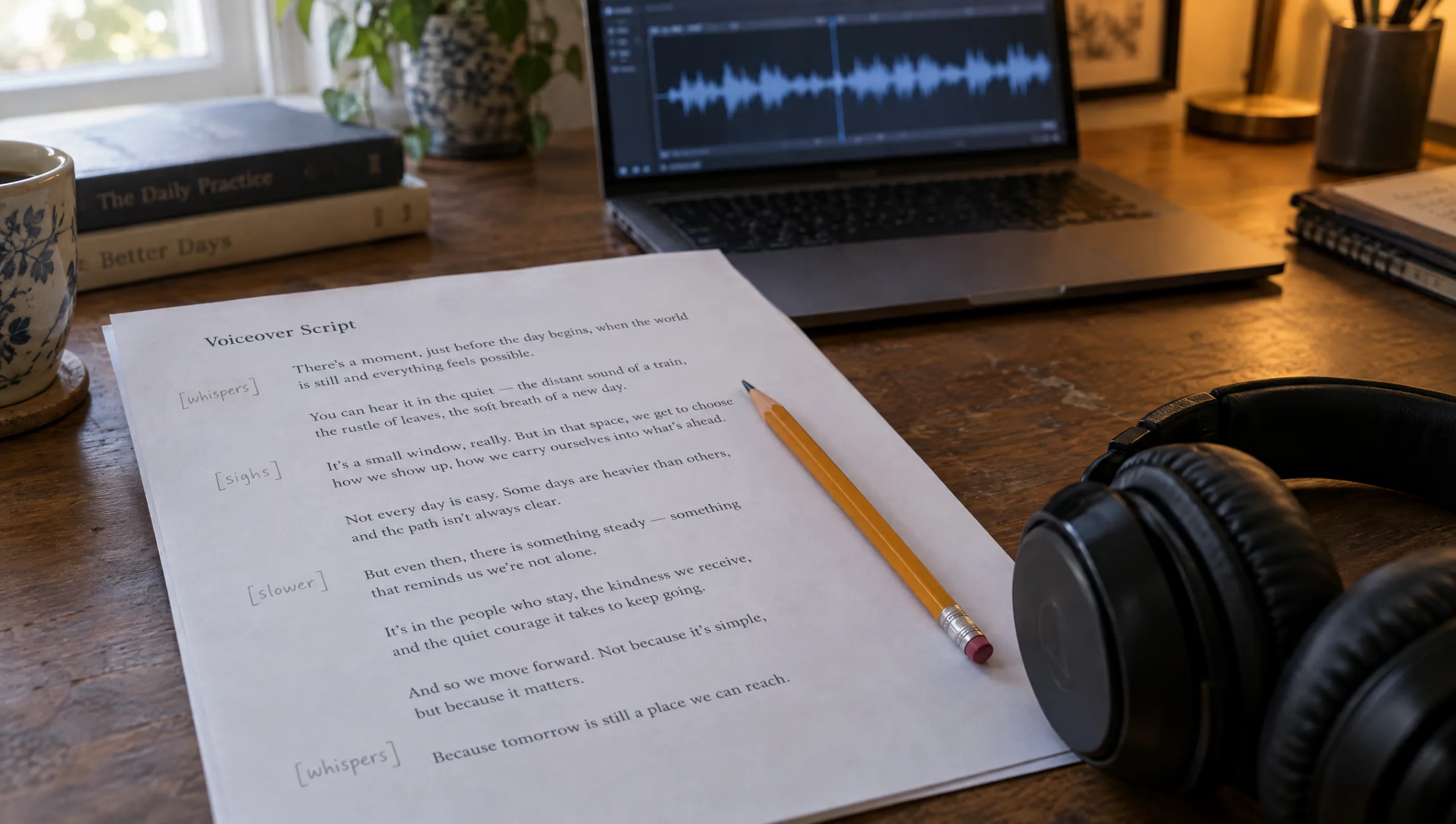
Part 2: the same script formatted for ElevenLabs v4 using restrained performance directions such as [thoughtful], [storytelling], [slightly amused], [anxious], [whispers], [voice trembling], [crying softly], [relieved], [tenderly], [reflective], [warmer], [quiet confidence]. Write a pause as an ellipsis. Use directions only when the performance genuinely changes. Do not overload every sentence with tags.
The final result should feel like the protagonist is trusting the audience with something real rather than performing emotion for attention.
The Three Checks
The script that comes back is a draft. Afterwards, three checks turn it into a film.
The Hook Test
To begin with, read the first line on its own. If it could open any creator’s film, any story, any brand, it is too generic and it goes. “In a world where we are always connected” fails. “I zipped my phone into my bag because it held ten years of us” passes, because only this story could start there. In short, a good hook is specific, creates a question, and does not answer it.
Prompt 2: Six Hooks
Then, once the first answer exists, go one step further.
Here is my script: [PASTE PART 1]. Give me six alternative opening lines for it, each under twelve words, each from a different hook type: a specific object, an action in progress, a line of quoted speech, a time stamp, a confession, and a small contradiction. Each must be something only this story could open with. Do not explain the story in the hook. Then tell me which one creates the strongest question and why.The Sentimentality Cut
Next, find every line that tells the audience what to feel or what the story means, and cut it. “I realised the phone was never the memory” is explaining. “She took my hand. The phone could wait” is showing. If the cut leaves a gap, the pictures fill it, not more words. The restraint rules from the emotional arc of a short film apply line by line here.
Prompt 3: The Cut
Last of all, the one that catches what the others miss.
Here is my script: [PASTE PART 1]. Mark every line that does one of these: tells the audience what to feel, explains what the story means, uses a motivational phrase, or describes an emotion by name instead of showing a body. For each one, give me a replacement that shows the same thing through an object, an action or a physical sign, in fewer words, or tell me to cut it with nothing in its place. Keep the total between 82 and 88 words.The Read-Aloud
Finally, read it aloud at the pace of someone telling a friend something true. Time it. If it runs under forty-five seconds, the pauses are missing and the voice will rush. If it runs over fifty-five, the escalation is fat. Mark where you breathed, because those are where the ellipses go in Part 2.
The Worked Example
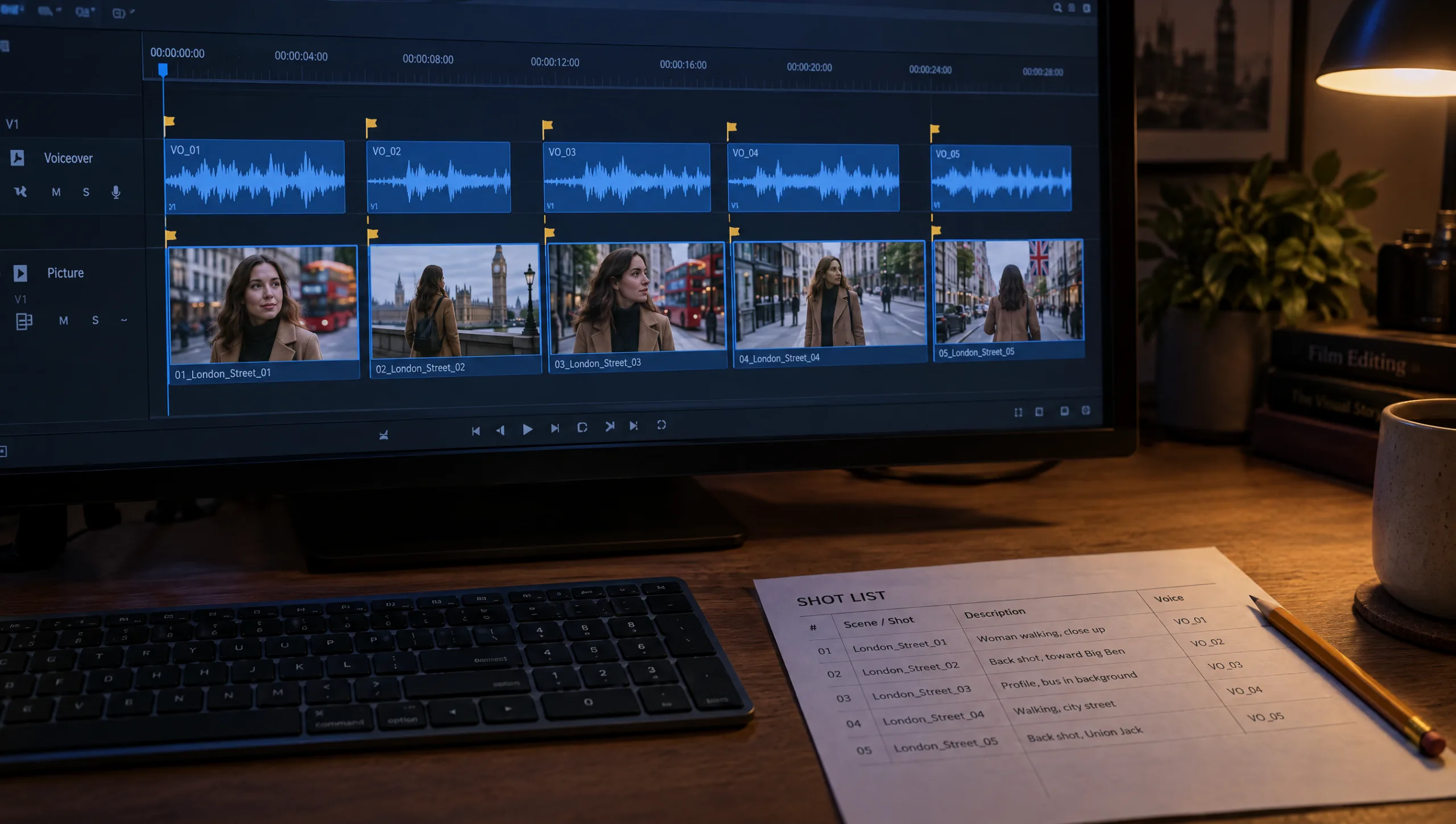
For the phone film, for instance, the story information came straight from the nine beats in part 5. Protagonist: a mother. Real event: a phone stolen on a London street. Vulnerability: she keeps every photograph of the last ten years on it. Lowest moment: raising an empty hand to photograph the light. Kama muta moment: her daughter says one word and takes the hand. Physical connection: the hand held, a laugh that turns. Opening callback: the phone, zipped into the bag.
The first draft explained too much and ran long. Then the hook test replaced the opening, the cut removed the landing line, and the read-aloud found the breath before “Mum”. The result is eighty-six words, and the tagged version of it, with the before and after you can hear, is in directing an AI voiceover with ElevenLabs audio tags.
From the Script to the Character
Only now, with the script in hand, does the character begin, because every choice about her comes from it. Her description comes from the relationship sentence, her wardrobe from the vulnerability, the object she carries from the callback. That is building the AI character your script needs. The whole method on one page is The Art of Kama Muta.
Common mistake
Feeding the prompt an idea. “A story about a mother who loses her phone and realises what matters” is an idea, and the prompt will return an advert. The prompt needs the plain event. The zip, the form, the insurance policy that covers damage but not theft, and the one word. Specific in, specific out. Vague in, however, means motivational out.
A note from Patchy
Quick version
AI writes the fifty-second script with you once the plain event, the relationship sentence and the nine beats exist. The master prompt fills fifteen story fields from those and enforces three acts, restraint and 82 to 88 words. It returns the clean script plus the same script tagged for ElevenLabs v4. Then three checks follow. The hook test on the first line, the sentimentality cut on every line that explains, and the read-aloud for pace and breath. The AI holds structure. You choose the moment.
Your move
Fill the fifteen fields from your nine beats, nothing invented, and run the master prompt. Then run Prompt 2 on the first line and Prompt 3 on the rest. Read the result aloud with a timer. If it lands between forty-five and fifty-five seconds and opens on something only your story could open with, you have a script.
Get the prompts. The master prompt and both checks are in the free Prompt Library under Story.
Related articles
- The Art of Kama Muta, the pillar guide
- directing an AI voiceover with ElevenLabs audio tags
- how to write a 50-second story for an AI short film
- building a prompt library that pays for itself
Paid next step: The Kama Muta Storytelling Masterclass. It holds the full master prompt including Part 3, the emotional moment finder, the six hook types and three case studies with their first and final drafts.
Frequently Asked Questions
Can AI write an emotional short film script?
Yes, once the real event and the relationship are clear and the brief enforces structure and restraint. Left to itself, however, it writes adverts. Given the master prompt and a plain event, it writes a draft worth cutting.
How long should a fifty-second voiceover script be?
82 to 88 spoken words. The master prompt enforces the count, and the read-aloud confirms the pace.
What is the hook test?
Read the first line alone. If it could open any story, it fails. It must be something only this story could begin with, and it must raise a question without answering it.
Should I use Claude or ChatGPT for this?
Either, because the brief matters far more than the model. Run the same prompt in both and keep the draft that needs fewer cuts.







Read the Comments +