
STORYTELLING AND SCRIPTS · THE ART OF KAMA MUTA, PART 1
A message arrives at eleven at night from someone you have not heard from in years. It says, in short: I watched your film twice. The second time I called my mother. You read it, and something happens in the middle of your chest before you have decided how to feel about it. Then your throat tightens a little. Your eyes are not wet, but they could be. For a second you want to call someone too. That reaction has a name, and it is therefore the subject of this whole series. This article is the foundation. It covers what the word means and where it comes from, what sets it off, what it does to the body, what it makes people do afterwards, and what it is not.
At a glance
- Kama muta is Sanskrit for moved by love. It is the name a research group gave to the feeling English speakers call being moved, touched or heartwarmed.
- The trigger is a sudden increase in closeness: a bond that strengthens, begins, returns or becomes vivid, all at once.
- The body signs are moist eyes, a lump in the throat and warmth in the chest. Sometimes goosebumps, or a hand to the heart.
- Afterwards, people want to hug, help, stay close and tell someone. That is why moved audiences share films.
- It is not sadness, not awe, and not nostalgia, though it can arrive alongside any of them.
You will need: nothing but a quiet ten minutes and one memory of being moved.
Where the Word Comes From
Many people assume kama muta is Japanese. In fact, it is not. The words are Sanskrit, and together they mean moved by love. A group of psychologists in Norway and the United States chose the name around 2017. They had spent years studying a feeling that every language seems to have, and that no English word covered cleanly. Being moved, being touched, heartwarming, a lump in the throat: each phrase catches only part of it. They wanted one term that carried none of the old baggage, so they borrowed from a language none of their participants spoke.
If you had a Japanese idea in mind, you were probably thinking of mono no aware. That is the gentle ache at the passing of things. It is a real and beautiful concept, and a cousin of our feeling, because both are quiet and both live near tears. However, it is not the same thing. Mono no aware is about transience, whereas kama muta is about connection. The difference matters for a filmmaker, because you build for them in different ways.
What Sets It Off
The research gives one clear trigger, and it is certainly worth memorising. Kama muta arises when a close, warm, family-kind bond suddenly becomes stronger, begins, returns, or becomes vividly noticeable. Every word in that sentence is doing work, so read it twice. The bond has to be the warm kind. Parent and child, old friends, lovers, a person and a dog, or strangers in a moment of kindness. The change has to be an increase in closeness rather than a loss. And the change has to be sudden.
That last part, in particular, is the one filmmakers miss. A warm relationship on its own does not produce the feeling. Two people who love each other, sitting happily on a sofa, produce nothing. Separate those two people for a year, then let one walk through the door, and almost everyone watching feels it. In other words, the feeling lives in the moment of change. It is the surge, not the state.

Where It Shows Up in Life
Once you know the trigger, you see it everywhere, because it is everywhere. Reunions at airports. The vows at a wedding. Homecoming videos. A stranger paying for a coffee. The child who runs across a room to hug a grandparent. An old dog that remembers. A national anthem sung badly by a crowd who mean it. A kind message from someone who did not have to send it. The cute animal video and the quiet film are using the same lever. Every culture builds practices around it, which is the subject of the art of emotional storytelling (coming soon).

What It Does to the Body
Importantly, the feeling has a body, and the body signs are consistent across the cultures the researchers studied. Moist eyes or actual tears. Then a lump in the throat. Warmth or a swelling sensation in the centre of the chest. Sometimes goosebumps or chills. Often a hand that goes to the heart without being told. Sometimes a catch in the breath, or the urge to say “aww” out loud. People report the feeling as pleasant even when it comes with tears, which is one way to tell it apart from grief.
For a filmmaker, this list is therefore a gift. It tells you exactly what to put on screen. When your character is moved, for instance, you do not need dialogue. You need the hand to the chest, the breath that catches, the eyes that fill, the laugh that comes just before the cry. Those are the signs the audience recognises from their own body, and seeing them on screen triggers them in the chair. The camera article in this series, making connection visible (coming soon), builds its whole shot grammar on this list.

What It Makes People Do
This is the part that makes kama muta the engine of a film that travels. After the feeling, people want three things, and they want them at once. They want to be closer to the people in the moment, or to anyone near them. Then they want to help, give, or commit. And they want to tell someone, to share what they just saw. The researchers found that moved people are more likely to donate, to volunteer, to reach out, and to pass the thing along.
Now think about what that means for a fifty-second film. A film that produces sadness gets a sigh and a scroll. One that produces awe gets a “wow” and a scroll. The film that produces kama muta gets sent to someone, with a message that says “this made me think of you”. That is the difference between a view and a share. It is why this series builds for this feeling and no other.
What It Is Not
Three feelings are regularly mistaken for kama muta, and a film that aims at the wrong one therefore lands wrong.
Sadness is the first. Sadness comes from loss, whereas kama muta comes from closeness arriving. They can sit side by side, because closeness often arrives after loss, and the tears look the same from outside. But a film that only shows the loss, with nothing arriving, produces sadness alone, and sadness does not travel.
Awe is the second, and the most common in AI film. Awe, by comparison, comes from something vast: a mountain, a cathedral, a galaxy, a very great talent. It makes people feel small, while kama muta makes people feel close. A drone shot over a glacier is awe. A hand taken on a street is kama muta. Many AI films reach for awe because the tools make it easy, and then wonder why nobody felt anything they could name.
Finally, nostalgia is the third. Nostalgia, in short, is warmth for a past that is gone. It can trigger kama muta if the past suddenly returns, as when a song brings back a person. On its own, though, it is a soft, backward-looking feeling, and it does not make anyone pick up the phone.
Three Prompts to Find It in Your Own Life
The series builds every film from a real moment of connection, so the first job is to find yours. Run these in Claude or ChatGPT, or simply answer them on paper.
Prompt 1: The Moment Finder
First, the prompt that helps you remember.
I am looking for real moments from my own life, or moments I witnessed, when a close relationship suddenly became stronger, began, returned, or became vividly clear. Ask me five questions, one at a time, to help me remember them. Focus on reunions, unexpected kindness, forgiveness, recognition, someone showing up, or a hand taken. After each answer, reflect back in one line what the relationship was and what suddenly changed. Do not add drama or invent details.Prompt 2: The Feeling Check
Once you have a moment, test it against the trigger before you build anything on it.
Here is a moment from my life: [DESCRIBE IT IN PLAIN LANGUAGE]. Tell me whether it fits the kama muta trigger: a warm, close bond that suddenly strengthened, began, returned, or became vivid. Answer in three lines: what the bond is, what the sudden change was, and whether the feeling it produces is being moved, or instead sadness, awe or nostalgia. If it does not fit, say what is missing.Prompt 3: The Body Signs
Finally, because the camera films bodies rather than feelings, find the signs.
For this moment: [PASTE THE MOMENT]. List the physical signs a person feeling kama muta would show, choosing from moist eyes, a lump in the throat, a hand to the chest, a caught breath, a laugh that turns into tears, goosebumps, or moving closer. Then tell me which two signs a camera could show in a single close-up without any dialogue.Why This Matters for the Rest of the Series
Everything that follows depends on this definition, because every later step uses it. The next article shows how storytellers in every culture have built for this feeling for thousands of years. After that comes the case for starting from the story rather than the tool. Then the emotions a film must travel through, the structure, the AI script, the character, the camera, and finally the voice. Each step therefore assumes you can tell the feeling apart from its cousins. If you can, you can build it on purpose. The pillar guide, The Art of Kama Muta, holds the whole map.
Common mistake
Aiming for emotional. In practice, “emotional” is not a target. Sadness, awe, nostalgia and being moved are four different feelings. Each has its own trigger and its own effect on what the viewer does next. A film that aims for emotional usually lands on sadness, because loss is easy to show. Aim for the surge of closeness instead, and the film will get shared.
A note from Patchy
Quick version
Kama muta is Sanskrit for moved by love, the research name for being moved. It is set off whenever a close bond suddenly strengthens, begins, returns or becomes vivid. The body shows it as moist eyes, a lump in the throat and warmth in the chest. Afterwards people want to be closer, to help, and to tell someone, which is why moved audiences share. It is not sadness, awe or nostalgia, and a film that aims at those lands somewhere else.
Your move
Tonight, write down one moment, in plain language, when connection suddenly arrived in your life or in front of you. Run Prompt 2 on it. If it passes the feeling check, keep it. That moment is the seed of your first film, and the next articles show you how to grow it.
Get the prompts. All three prompts from this article are in the free Prompt Library under Story.
Related articles
- The Art of Kama Muta: the pillar guide
- how to write a 50-second story for an AI short film
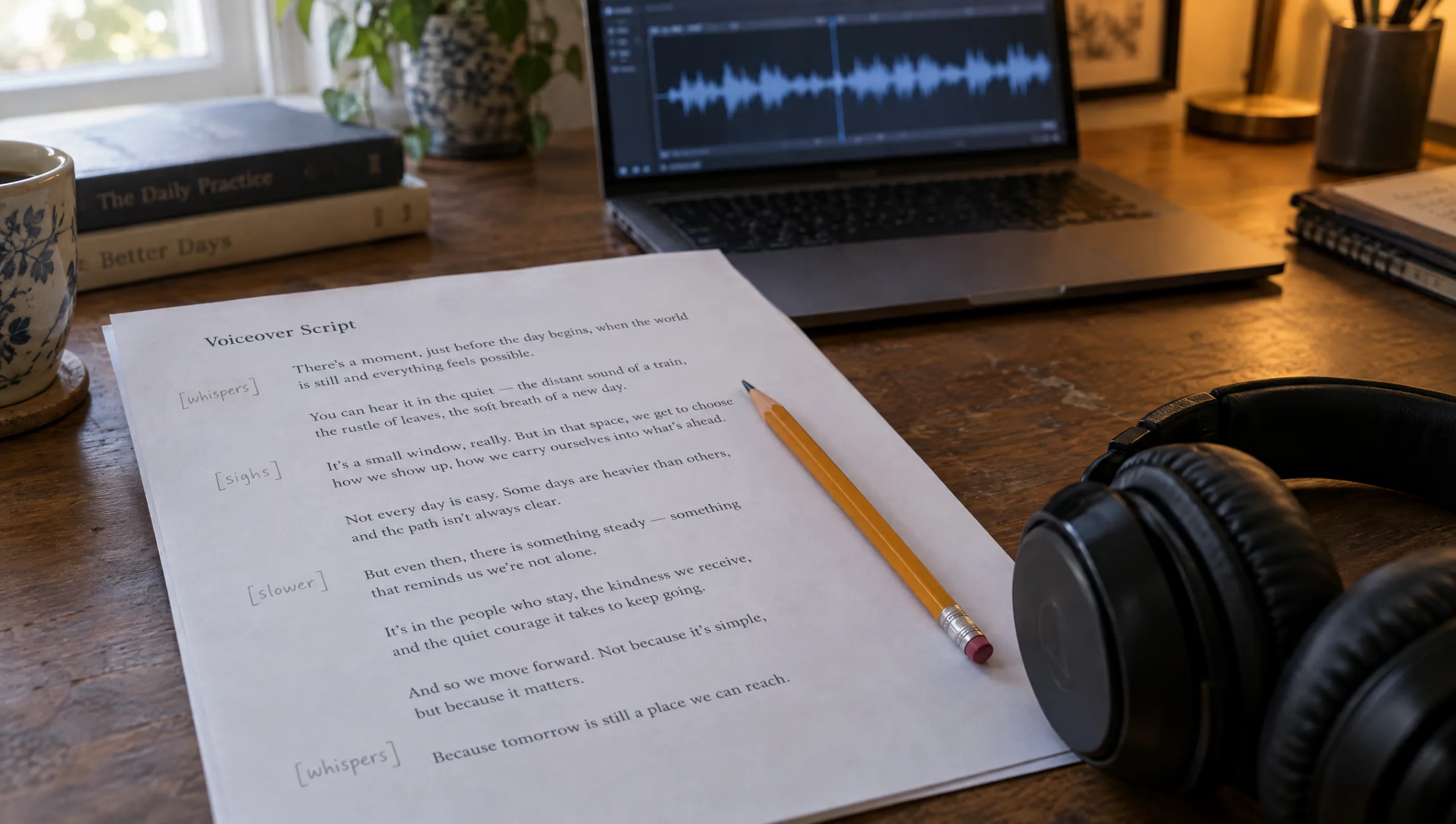
- directing an AI voiceover with ElevenLabs audio tags
Paid next step: The Kama Muta Storytelling Masterclass, the complete method from the real event to the finished film. It includes the master prompt, the moment finder, three case studies and the emotional integrity audit.
Frequently Asked Questions
Is kama muta a Japanese word?
No. It is Sanskrit, meaning moved by love, chosen by a research group as a neutral name for the feeling of being moved. The nearest Japanese cousin is mono no aware, the gentle ache of things passing, which is a different feeling.
What is the difference between kama muta and sadness?
Sadness comes from loss, whereas kama muta comes from closeness suddenly arriving, often after a loss. The tears can look the same, but moved people feel warm and want to reach out, while sad people withdraw.
Can a film make someone feel kama muta on purpose?
Yes. First open a distance between people the audience cares about, hold it, then close it suddenly in one visible act. Show the body signs rather than explaining the feeling. The rest of this series is that method.
Why do people share films that move them?
Because the feeling makes people want to be closer and to tell someone. Sharing the film is the quickest way to do both.







Read the Comments +